
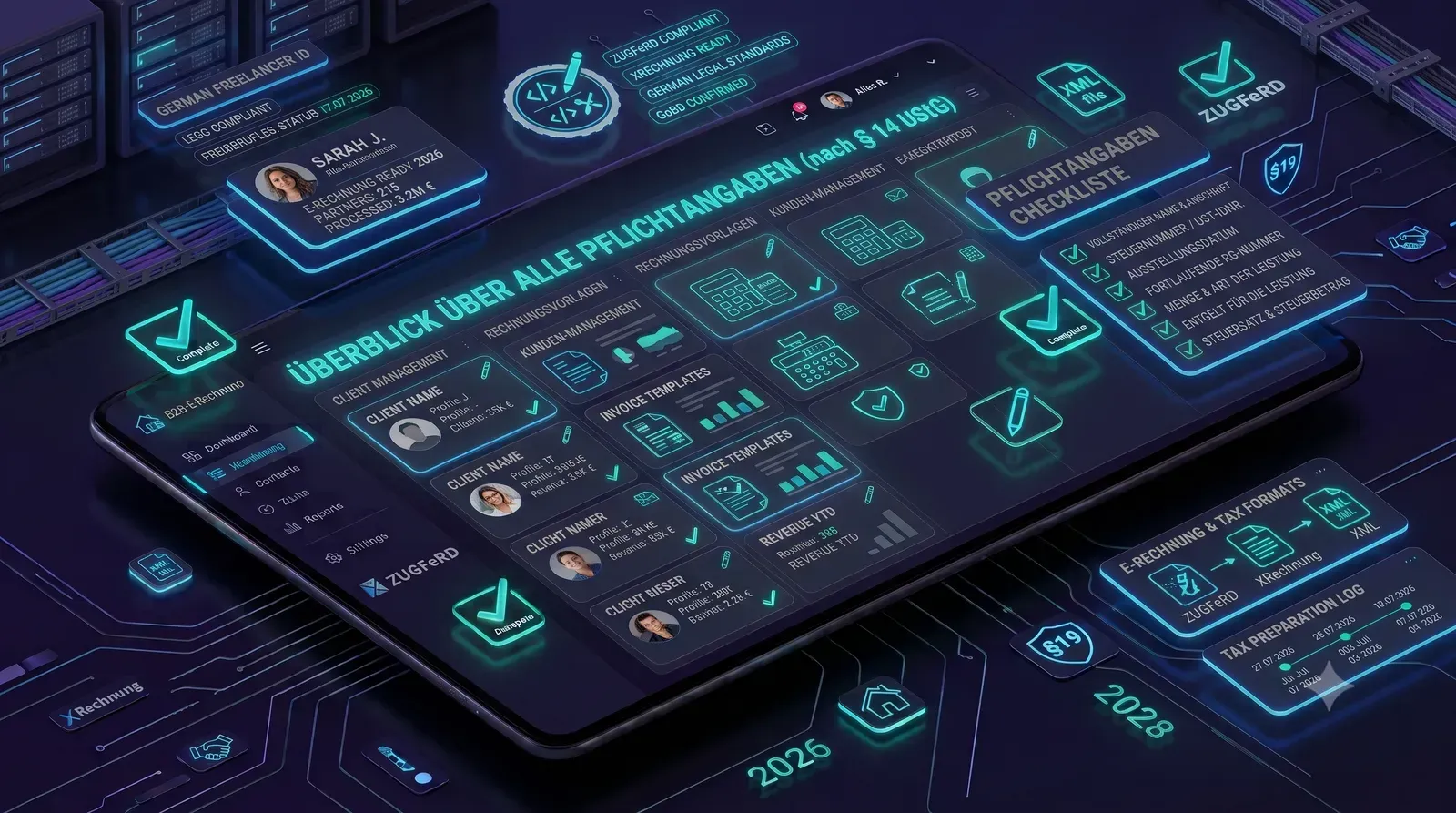
Writing an invoice in Germany is far more than an informal request for payment - it's a strictly regulated tax document. § 14 of the German VAT Act (Umsatzsteuergesetz, UStG) specifies exactly which information an invoice must contain. This applies regardless of legal form - to freelancers (Freiberufler, e.g. software developers, designers, consultants) just as much as to trades (Gewerbetreibende) and companies.
If even one small detail is missing - an incomplete address, a forgotten invoice number, or too vague a description of services - the tax office can disallow your customer's input VAT deduction during an audit. In the B2B sector, a flawed invoice therefore inevitably leads to payment delays, since the customer's accounting department will demand a corrected reissue.
In this guide, we cover the 9 mandatory fields every standard invoice needs, the exceptions for small amounts, and why digitalization (e-invoicing) has made manual data-entry mistakes far more costly in 2026.
Freelancer note: unlike trades, freelancers generally don't pay trade tax (Gewerbesteuer) and don't need to register in the commercial register (Handelsregister); they usually determine their profit via a simple income-surplus statement (Einnahmenüberschussrechnung, EÜR). None of that changes the mandatory invoice fields under § 14 UStG, though - those apply to freelancers exactly as they do to any other business.
1. The 9 Mandatory Fields (invoices over €250)
Once the gross invoice amount exceeds €250, the following nine elements must appear on the document, clearly and unambiguously:
1.1. Full name and address of both parties
The invoice must state the exact legal name and full address of the supplying business (you) and the recipient (your client).
- Freelancers and sole proprietors must state their first and last name.
- Check the client's legal form carefully (e.g. GmbH, AG, UG).
1.2. Tax number or VAT ID
You must provide a tax identification number: either the Steuernummer issued by your local tax office, or the VAT ID (USt-IdNr.) issued by the Federal Central Tax Office. For intra-EU B2B supplies, both parties' VAT IDs are mandatory.
1.3. Date of issue
The exact date the invoice was created.
1.4. Sequential invoice number
An invoice number must be unique so every invoice can be identified unambiguously. It may combine digits and letters (e.g. RE-2026-07-142) - what matters is that the numbering is sequential and no number is reused.
1.5. Quantity and description of the goods/service
Generic phrases like "services" or "consulting" are not enough for the tax office. The description must be specific and industry-standard.
| Too vague | Tax-office compliant |
|---|---|
| IT services for August | Frontend architecture development (React, Next.js), 40 hours at €90 |
| Website consulting | Code review and CI/CD pipeline setup, 12 hours |
| Software programming | Backend API development (Node.js & PostgreSQL), Milestone 1 completed |
1.6. Date of supply / service period
State the day of delivery or the period during which the service was performed (e.g. "service period: July 2026"). This is mandatory even when it matches the invoice date.
1.7. Net amount broken down by tax rate
The invoice amount must be shown net (excluding tax). If different line items carry different tax rates (e.g. 19% and 7%), the net amounts must be broken down accordingly.
1.8. Tax rate and tax amount
The applicable tax rate (19% or 7%) and the resulting VAT amount in euros must be shown transparently.
1.9. Gross invoice amount
The final total, including tax, that the client has to pay.
To make sure your layout covers all of these requirements before you send anything, you can build your invoices on our Solobuch platform.
2. The exception: small-amount invoices (under €250)
To keep everyday admin overhead low (e.g. for office supplies or a taxi receipt), invoices with a gross amount up to €250 (§ 33 UStDV) are subject to simplified rules.
A valid small-amount invoice only needs:
- The full name and address of the supplying business.
- The date of issue.
- The quantity and type of goods/service.
- The gross total and the applicable tax rate (e.g. 19%).
You don't need to state the buyer's name, a sequential invoice number, or your tax number.
3. Special cases and additional requirements
Depending on your business situation, further fields can become mandatory. On VAT specifically, you generally have two options:
- Standard taxation (Regelbesteuerung): You state regular VAT openly (usually 19%; in some creative professions, licensing copyright usage rights can qualify for 7% - whether that applies in your specific case needs to be checked separately). This tax isn't yours to keep; you remit it to the tax office via your VAT return.
- Small business rule (Kleinunternehmer, § 19 UStG): If your turnover is below the statutory thresholds, you must not show VAT at all. An explanatory sentence is mandatory (e.g. "Gemäß § 19 UStG wird keine Umsatzsteuer berechnet").
- Reverse-charge procedure: When the tax liability shifts to the recipient (e.g. cross-border B2B services within the EU), no VAT is shown - instead you must add the note "Steuerschuldnerschaft des Leistungsempfängers (Reverse Charge)".
- Early-payment discount (Skonto): If you grant a discount for fast payment, the terms must already be stated on the invoice.
4. Invoicing in 2026: e-invoicing doesn't forgive mistakes
With mandatory B2B e-invoicing (XRechnung, ZUGFeRD), the margin for error has changed dramatically. A missing field (like the service period) on a Word document used to mean a phone call from the other side's accounting department at worst.
With structured e-invoices, a missing mandatory field means your client's system automatically rejects the XML file. The invoice is legally considered "not delivered," and the payment deadline never starts running.
Don't leave compliance with these formal requirements to chance or a word processor. Use software that lets you create an e-invoice without errors - it blocks the export if fields required under EN 16931 are missing. If you export invoices from another system, it's worth using our ZUGFeRD Validator to check the syntax in seconds before sending them to a client.
5. Conclusion & Key Takeaways
Writing an invoice requires precision. An invoice that's correct under § 14 UStG is the foundation for smooth business dealings and on-time payments.
- Completeness: Check every invoice over €250 against the 9 mandatory fields.
- Detail: Avoid generic descriptions. Describe your goods or service so an auditor understands it immediately.
- Digital risk: If mandatory fields are missing on an e-invoice, the XML is invalid and gets rejected automatically.
- Automation: Use modern cloud tools and validators to eliminate formal errors entirely.


